
 A Roman-era tomb in the shape of a small pyramid has been discovered in the Dakhla Oasis of Egypt’s Western Desert. The tomb is a combination of Egyptian, Greek and Roman cultural and funerary traditions.
The tomb was found at Bir al-Shaghala, part of the necropolis of the ancient city of Mut, capital of the oasis in the Ptolemaic and Roman periods. One of seven major oases in Egypt, Dakhla covers 770 square miles in the deep desert about 465 miles southwest of Cairo and has been continuously inhabited for more than 2,000 years. The tomb is about 1,700 years old.
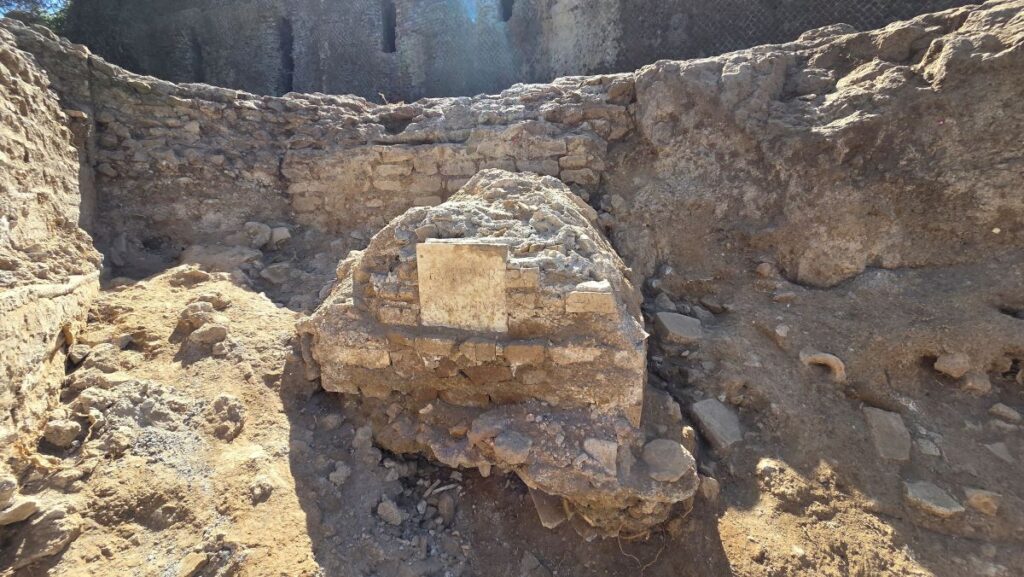
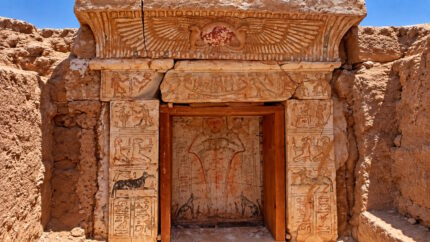
 It was built with mud bricks arranged in a pyramidical shape, but unlike its monumental pharaonic inspirations, the tomb was small, intended to hold the remains of one husband and wife. Fourteen steps lead down to the entrance to the tomb: a sandstone doorway built in classic dynastic Egyptian style and carved with the iconography of the traditional Egyptian religion. A winged sun disk flanked by two cobras and bracketed by bundles of papyrus reeds was carved on the cornice, while funerary spells in hieroglyphic texts were carved on the door jams to guard and protect the deceased on their journey to the underworld. The entrance was sealed with a heavy block of stone engraved with the god Osiris and more hieroglyphic protective spells.
The stand-out feature among the funerary reliefs is on the lintel stone above the doorway. It depicts the sun god Ra’s nocturnal journey through the underworld as described in the Amduat, an important funerary text from the New Kingdom that was discovered carved on the walls of the tombs of pharaohs. It was exclusively used for pharaohs and very few select high officials until the 21st Dynasty (1077-943 B.C.).
This is the first time the Amduat scene has been found in the necropolis, and it is an extraordinary testament to the longevity of traditional pharaonic religion in Egyptian culture even after many centuries of Ptolemaic Greek and Roman rule.
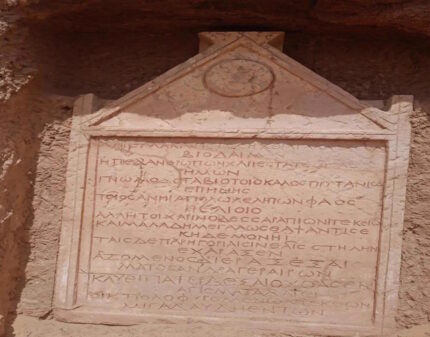 Inside the tomb is a mudbrick hall under a vaulted roof. The roof had partially collapsed. Two burial chamber built of mud brick coated with mortar were on the right side of the hall, and the pyramid structure was built above them. Embedded in the south wall is a funerary stele with a funerary poem in Greek painted in red letters. It is 19 lines long and dedicated to one Pisechtes who may have been a judge. It dates to the late 3rd or early 4th century.
The excavation also uncovered a sandstone offering table positioned above a sandstone purification basin, a collection of pottery vessels, and a bronze coin bearing a relief depiction of the Roman Emperor Constantine.
Archaeologists also found evidence suggesting the tomb may have been reused later. A mudbrick chapel was discovered above the main entrance, with a funerary shrine in front of it consisting of four square mudbrick columns. […]
Hisham El-Leithy, Secretary-General of the SCA, said the tomb’s architectural features, inscriptions and funerary texts provide important information about funerary practices and the cultural and religious life of the Dakhla Oasis during the Roman period.