
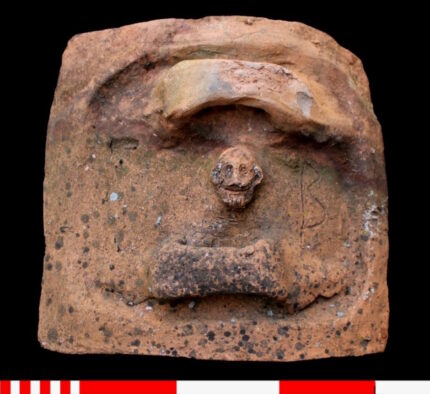
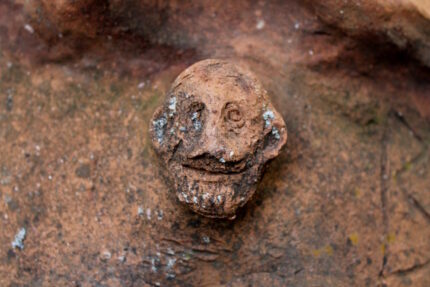
 A terracotta sarcophagus bearing a relief of a Silenus mask has been discovered at the ancient site of Attouda in western Turkey. It is the first time one of the cylindrical terracotta sarcophagi typical of Roman Anatolia has been found with a Silenus-like figure on the lid. The findings have been published in the journal CEDRUS.
Silenus was the older satyr who was teacher to the god of wine Dionysus and was said to be the wisest and drunkest of the god’s companions. He is commonly depicted on Roman funerary art as part of Dionysian processions, representing the mystery cult’s beliefs of eternal renewal and life after death. Silenus’ exaggerated features (big eyes, mouth and nose) also cast him in a protective role at time. Archaeologists believe the silene mask on the sarcophagus served an apotropaic function, a symbolic protector of the dead.
Attouda, today within the village of Hisar in Denizli Province, was a frontier settlement built of a hill bounded by steep cliffs on three sides. That made it easily defensible, an important quality for a town straddling the regions of Caria, Phrygia, and Lydia. Archaeological evidence indicate it was founded in the 7th-6th century B.C. and has been continuously occupied ever since.
In the Roman Imperial period, cylindrical terracotta sarcophagi made of local red clay were one of a variety of burial types used in the settlement and in other ancient cities in Anatolia and the Lykos Valley. The sarcophagi are believed to have been manufactured in local or regional workshops, as their weight, fragility and unwieldiness would have made them difficult to transport over long distances.
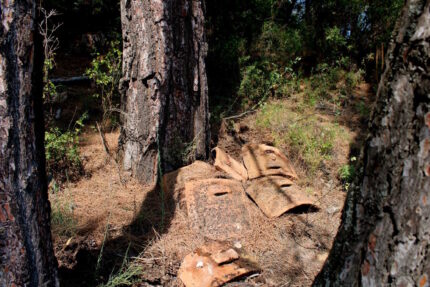 The sarcophagus was found in six fragments in a 2023 ground survey at Musalla, just south of the ancient city in the Attouda necropolis. The cylindrical terracotta sarcophagus had been damaged by later agricultural activity, breaking into six pieces that were then moved to the edge of the farmed land. The recovered pieces were moved to the Denizli Museum for conservation and study.
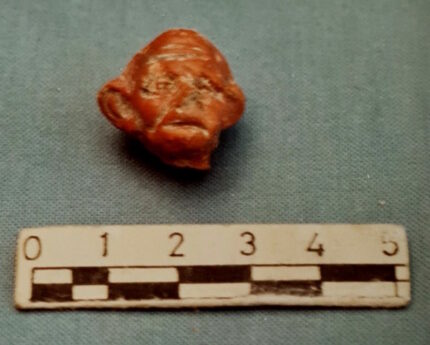 When intact, the sarcophagus was about 55-60 cm (ca. 22 inches) in diameter with a curved lid approximately 33-30.5 cm (ca. 13 inches) wide. In the center of the lid was a small human face with a bald, bulbous head, large eyes, broad, flat nose, thick, deeply incised lips that turn up at the corners into a smile and a short beard. These grotesque features are found on Silenus masks from the 1st century found in Attouda and other regional necropoli. An intact one from the Tralleis necropolis had three suspension holes for cords suggesting it was hung inside a tomb for apotropaic purposes. A large fragment of a very similar head was found in a tomb at Attouda, demonstrating that Silenus figures were part of the city’s funerary traditions.
 Also notable on this lid is a Greek letter Beta carved into the clay next to the mask relief. It is seven cm high, so longer than the silene face itself. Letters have been found on other terracotta burial containers from the area. Archaeologists hypothesize that they were maker’s marks of the workshops or artisans who created the sarcophagus.
The dating is a challenge because the sarcophagus was not found in its original context, but stylistic comparisons suggest it was made in the 1st or 2nd century A.D.
Since the findspot lies within the Attouda necropolis, and a head fragment belonging to a Silenus figurine had previously been recovered from another tomb, the use of Silenus iconography cannot be regarded as coincidental. Rather, this evidence suggests that protective figures associated with the Dionysian cult were deliberately incorporated into the funerary architecture and burial decoration tradition of Attouda. The presence of the Dionysian cult, as documented by the city’s coinage and inscriptions, further supports this interpretation. Accordingly, the sarcophagus lid decorated with a Silenus-head relief should be regarded not merely as an isolated decorative element, but as tangible evidence reflecting the relationship between Dionysian beliefs and funerary rituals within the Attouda necropolis.