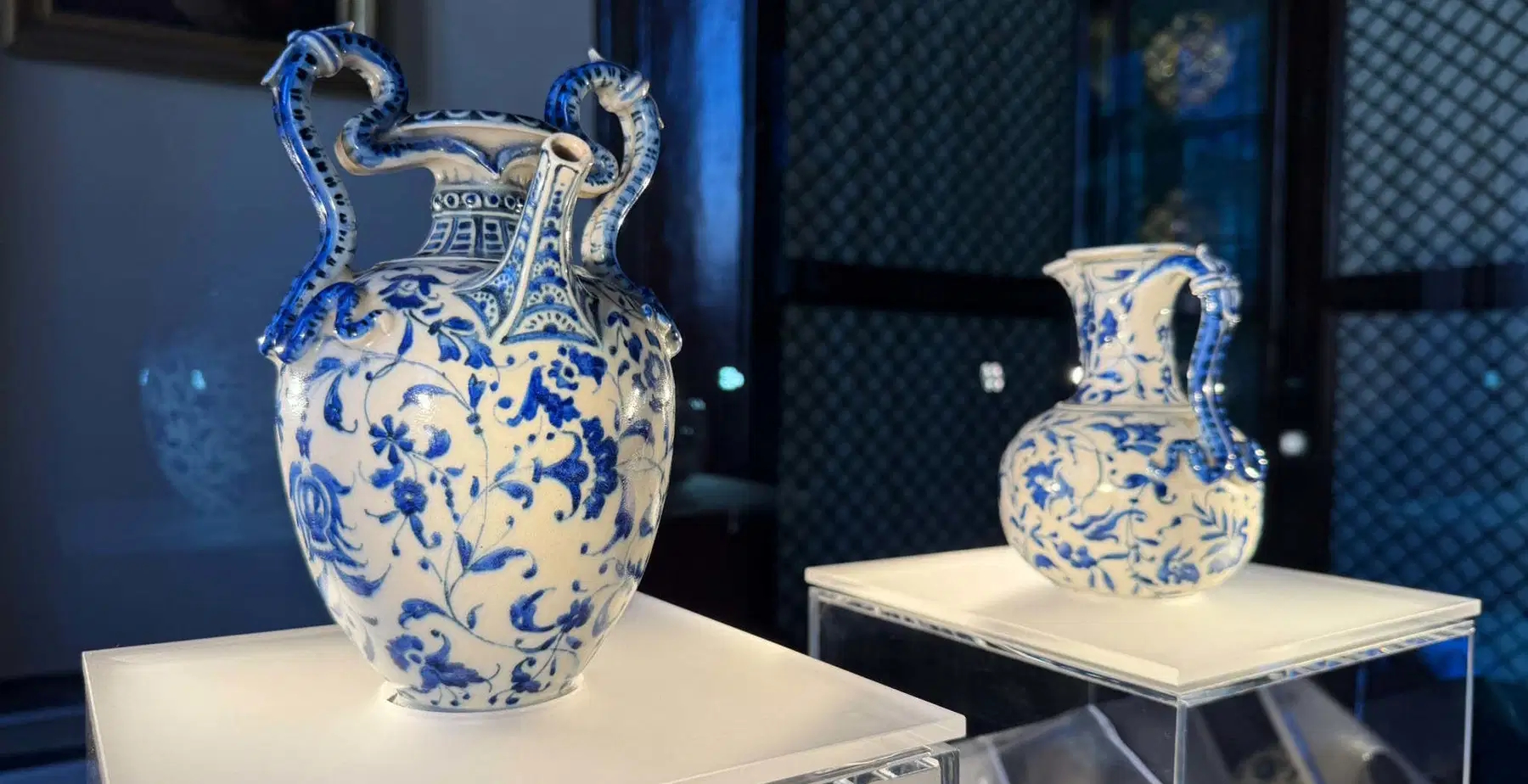

 Two rare Florentine vases from the 16th century made in the attempt to produce in Europe porcelain of like quality and type as that imported from China have been donated to the Museum of San Marco in Florence. They are two of only 60 to 70 surviving pieces manufactured in the Casino di San Marco complex, established by Grand Duke Francesco I de’ Medici. Today only one other example of Medici porcelain is in a Tuscan Culture Ministry institution, so the donation of two vases triples the number in public collections in their place of origin.
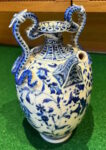
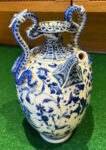
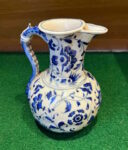
Manufactured between 1575 and 1585, both vases are white with blue decoration and feature striking serpentine handles.
The first vessel is a jug, or mesciroba, 16 centimeters tall. It has a globular body, a long cylindrical neck, and a spout with a distinctive triangular cross-section, while the handle consists of two snake-like forms joined together—a design that gives the object a particularly elaborate appearance. The white surface is decorated in deep blue with peonies, daisies, and lotus flowers. The decoration draws specifically on Chinese porcelain from the Ming Dynasty and the Yongle period, but the Eastern model is not the object’s sole source of inspiration. The shapes of the flowers, in fact, derive from a decorative tradition that had already been influenced by Islamic metalware, while the structure of the vessel recalls the Hispano-Moorish mescirobes with tall necks and spheroidal bodies produced in the Valencia region between the 14th and 15th centuries. […]
The second piece, on the other hand, is slightly larger, about 20 centimeters tall, and has a different shape. It is a vase with an ovoid body, two opposing serpentine handles, and a hexagonal spout protruding from the body (its shape finds a parallel in the grotesque-decorated Urbino majolica pieces that had already been part of the Medici collections since 1569).
The grand-ducal workshop of Casino di San Marco was one of several founded by Francesco I as a laboratory for experimentation where painters, sculptors, academics and artisans worked together to investigate natural phenomena and invent new materials and processes. Francesco had a great personal interest in alchemy and glassmaking, as well as in collecting at and antiquities, and he invested much time and money promoting technical innovation by marrying the experimental sciences in the applied arts.
On the first floor of the palace alone were glass works, an alchemy laboratory, foundries for metal work, including the forging of steel tools hard enough to hew porphyry, furnaces where rock crystal was fused to create decorative objects and precious stones (emeralds, rubies) were counterfeited, and ovens for producing a soft paste porcelain that became known as “Medici porcelain.”
In 1575, the Florentine manufactory succeeded in producing the first examples of what would come to be known as “Medici Porcelain, ” a soft-paste porcelain that represented Europe’s first successful attempt to reproduce the Eastern material. The venture was short-lived, however: the very high temperatures required for firing and the high production costs limited its development, and the manufactory ceased operations after the death of Francesco I in 1587, resulting in a very limited production run (the inventories of the Medici court recorded about three hundred pieces, but today only sixty or seventy survive worldwide). It is in this context that the donation of the two vases to the Museum of San Marco should be viewed, as it expands an already extremely rare presence in Tuscan public collections.
Both vases bear the workshop’s mark on the bottom: the dome of Santa Maria del Fiore painted in blue, surmounted by the letter “F,” the initial identifying Florence. This is one of the features that allows us to recognize production linked to the court of Francesco I and immediately connects the objects to the experimentation carried out in the Tuscan capital.
The vases have gone on display in the Museum of San Marco’s Greek Hall, where they will be neighbors with Renaissance majolica apothecary jars from the Dominican convent that was across the street from the Casino di San Marco.