
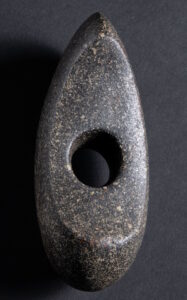
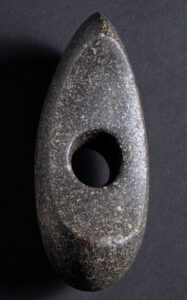
 A prehistoric battle-axe head discovered in 1974 at Scarthingwell, near Tadcaster in North Yorkshire, has been temporarily blocked from export to give museums and local collectors a chance to buy it and keep it in the UK where it can be on public display. It is more than 4,000 years old, dating to the Bronze Age.
The battle-axe provides valuable insight into the role these objects played in expressing status, identity and changing ways of life in Neolithic and Bronze Age Britain. It also has significant research potential, offering future generations an opportunity to learn more about this period of our shared national history.
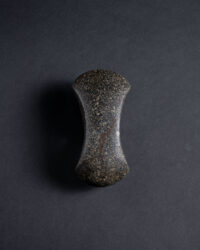 Discovered by accident during construction work but only reported to the Portable Antiquities Scheme in 2012, the axe head is made of diorite, a hard igneous rock with a distinctive mottled pattern. It has curved edges, a central hole for the handle and highly polished surface that emphasizes the natural pattern in the stone. It is in exceptional condition.
According to Tim Pestell, member of the Reviewing Committee on the Export of Works of Art and Objects of Cultural Interest (RCEWA), cutting a hard stone like this into a tapered shape with a central hole and then polishing it to a bright shine would have required hundreds of hours of hard work. The emphasis on aesthetics in the production of the piece suggest it was not just a utilitarian device.
In a profound period of change, the Early Bronze Age witnessed a society previously restricted to flint tool technology adopting metalwork. Despite this, battle axes became some of the most powerful symbolic objects, labelled by one scholar as ‘blunt instruments of power’. Made of stone rather than metal, they conveyed important social, sacred and political messages.
The axe head’s outstanding connection the British history, aesthetic significance and importance to the study of artifacts like it meets the first, second and third of the Waverley criteria used by the committee to make its determination. On the recommendation of RCEWA, Heritage Minister Baroness Twycross imposed a temporary export bar on the prehistoric artefact. Potential purchasers have until December 22 to make a good faith effort to raise the funds to acquire the axe head for the recommended price of £15,000 ($16,700).