
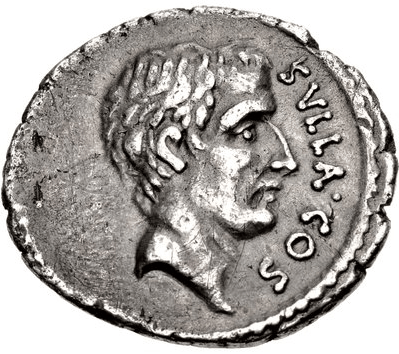
This week, we’re going to talk about the version of the Roman Republic created by the murderous dictator Lucius Cornelius Sulla in the late-80s B.C., what I am going to term here the ‘Sullan Republic.’ In particular, I want to lay out the nature of that political order, stressing the important ways in which it was not a continuation of the Roman Republic which had existed from 509 to 88 B.C. (or even the ‘republic of the nobiles‘ which had existed from c. 300 to 88) but in many ways a new thing. Viewed in that context, the fact that it failed utterly in just three decades speaks to how much less capable constructed it was than the earlier Roman political orders.
I think this is worth focusing on for two reasons. The first is simply that this distinction is often lost on students and enthusiasts. We have so much more evidence (as recently discussed!) for the Late Republic and specifically for the period of the ‘Sullan Republic’ that it tends to drown out everything else: Cicero’s republic gets understandably processed as the res publica as if it was the only one and that things had always worked that way.
Second, you may notice that the title structure for this post mirrors my retrospectives on Cleopatra VII and Alexander III. That is intentional: this is, in effect, my commentary on Sulla himself. My reasoning here is straight forward: almost any attempt to rehabilitate Sulla proceeds from his effort to ‘restore’ or ‘save’ the Roman Republic. It observes that Sulla seems to have been a sincere patriot who really believed in the republic (in an oligarchic, reactionary form) and then posits that he set out to ‘save’ the Republic and in some level did so. The reason for this approach is equally straight-forward: there is little else to defend in the man. There is no hint of the military virtuoso of a Caesar or Alexander in Sulla; he was certainly a very competent general, to be sure, but few of his military achievements were spectacular.1 In his conduct, there is nothing of the occasional glimpse of Alexander’s chivalry or Caesar’s mercy or even Octavian’s later-in-life forbearance – Sulla was cruel, ruthless and rapacious with some consistency.
So any defense of Sulla’s life and methods has to be predicated on the idea that he ‘saved the republic’ or some such thing. And I argue here that he did no such thing; rather than save the republic as it had been, he buried it (already slain by others) and built a new, inferior version atop its grave. That inferior version began falling apart almost immediately and wholly decomposed in 49, all within a single generation. Sulla thus ought to be judged a fairly comprehensive failure – all of his butchery and greed neither saved nor conserved anything and instead if anything further weakened what was left of Rome’s republican traditions.
But first, if you like what you are reading here, please share it, as I rely on word of mouth to reach new readers. If you really like it, you can support me, my academic work and my public writing, including this project on Patreon! If you want updates whenever a new post appears or want to hear my more bite-sized musings on history, security affairs and current events, you can follow me on Bluesky (@bretdevereaux.bsky.social). I am also active on Threads (bretdevereaux) and maintain a de minimis presence on Twitter (@bretdevereaux).
(Bibliography note: This can be a fairly short one – I am for the most part here following H.I. Flower, Roman Republics (2010) in the interpretation of the Sullan Republic, which Flower terms ‘Republic 6’ and which runs notionally to at least 60. There is more beyond this, such as A. Lintott, The Constitution of the Roman Republic (1999) and E. Gruen, The Last Generation of the Roman Republic (1995), and A. Keaveney, The Army in the Roman Revolution (2007), but for the most part one may find the relevant works in Flower’s bibliography. For the reader looking to get a grasp on the wider sequence of events in this period, H.H. Scullard, From the Gracchi to Nero (1959) remains a capable narrative, although I will be pushing back on its interpretation of Sulla as presenting mere ‘reforms’ that ‘restored’ elements of the pre-91 republic; more recent and also very solid is the aforementioned E. Gruen, The Last Generation of the Roman Republic (1995). Finally, this entire topic is unavoidably cast in the very long shadow of R. Syme, The Roman Revolution (1939), although it spares just a few pages for Sulla – but here I am also at variance with Syme’s review that presents Sulla’s bloodstained dictatorship as largely just reaffirming the Roman oligarchy that was already failing.)
The Situation
It is worth laying the groundwork here for the situation that Sulla and the Roman people were in by the period 83-81 when Sulla is in a position to impose his new republic. There is a tendency for this period to get somewhat limited mention in world history courses (often just treated as ‘Marius and Sulla’ as if they were dueling dynasts in the same way that Caesar and Pompey and Octavian and Antonius were) and thus often a failure to recognize how nearly total a break from what came before this moment was.
First we should note that in the run up to the explosion of civil war in 91 (note 91, not 88), there had been tremors. Our sources – most notably Appian – tend to begin their understanding of this period with the tribunates of Tiberius (133) and Gaius (123, 122) Gracchus and their violent ends. We’ve already discussed these, so no need to belabor the point. Modern historians often reach back a little further, recognizing in the irregular career of P. Cornelius Scipio Aemilianus (cos. 147, 134) many of the patterns – a general popular enough to buck the Senate, taking volunteers, holding office in defiance of the mos maiorum and/or the law – that would bear such poisonous fruit later. But Scipio Aemilianus never makes a disruptive play for power and dies in any event in 129, so if he posed any danger, it passed.
The boiling political issue from 122 to 91 was the question of citizenship for the socii. We’ve discussed this institution before – the subordinated communities of Italy got a ‘deal’ from Rome (which the Romans euphemistically referred to as an alliance) in which the socii were bound to Rome and required to supply troops to Roman armies but in exchange got protection from Rome, a (fairly ample) share in the loot of Roman conquests and no Roman taxes levied on them. This had been a good deal for a long time, but Roman overseas conquests altered the balance: increasingly Rome was getting not loot but tax revenue (of which the socii had no share) from its conquests and using those revenues – after the Gracchi – to pay for benefits (land distribution, grain distribution) which were restricted to Roman citizens. The balance of the deal had shifted and of course behind this was the understandable desire by the socii who had fought for Rome’s new empire for generations to share in legal equality at the top of it.

The response across Italy was clearly split – some socii ‘wanted in’ (wanted citizenship) and some ‘wanted out’ (wanted to dismantle Rome’s imperial system over Italy). From 123 to 91, we see repeated attempts to resolve this problem politically: various figures (e.g. Marcus Fulvius Flaccus (in 125), Gaius Gracchus (in 122), L. Appuleius Saturninus (in 100), and Marcus Livius Drusus (in 91)) had tried to advance various schemes to resolve this issue by expanding – to a greater or lesser degree – Roman citizenship in Italy. These efforts had failed for a few reasons: immediately, the Roman voters were mostly sour on these plans, recognizing that expanding citizenship would dilute their votes and share of the revenues of empire. Behind that, I think, it seems clear that while the Roman political elite increasingly understood this needed to be done, whoever did it would suddenly have the gratitude (and clientage) of millions of new citizens and thus be an unmatched political powerhouse – so this needed to get done but no one could afford to let their political opponents be the ones to do it. As a result, the Senate drag their feet on the issue rather than – as they had with hard geostrategic choices in the fourth and third centuries – presenting a united front to the Roman people.
The discontent of the socii after repeated failed efforts then boils over in 91, leading to the Social War (91-88). This is very important because it creates the ‘state of exception’ in which all of the chaos happens. The wild events of 88 (which set the stage for everything else) are, I think, impossible to understand except that they are occurring already in the context of a huge rupture of norms and traditions in which the same state is being shaken so hard it is experiencing a kind of political liquefaction.

In the event, the Roman Senate finally does the obvious thing in response to the mass rebellion of the socii: it offers citizenship to the socii if they will lay down arms. That works to separate the ‘hard cases’ (most notably the Samnites) who ‘wanted out’ from the ones that mostly ‘wanted in’ and allows Rome to win the war. But it creates a huge secondary question concerning on what terms the new citizens will be enrolled and that furthers the state of exception here: now not only is there an ongoing civil war but also we’re adding a huge number of new citizens to the Republic.
That leads to the events of 88. P. Sulpicius Rufus, an ambitious tribune (politically somewhat cornered by being in no small amount of debt) pivoted to trying to alter the distribution of the socii in Rome’s voting tribes to be more equal (and thus swamp existing Roman voters) and enlisted the aging Gaius Marius to help him. Marius’ price was one last chance in the saddle – command of an army to fight Mithridates VI of Pontus who had tried to pry Rome out of the Aegean while the Romans were distracted with the socii (the command had been delegated to Sulla, as something of a reward for his hard fighting in Italy, itself an echo of Marius’ own bad precedent from 107 to 100). Blocked legally, Marius and Sulpicius worked up a riot (including some of Marius’ veterans) and thereby pushed through a law giving Marius his command and redistributing the Italians; Sulla, who was consul in 88 had been in Rome to veto the proposal and was forced to flee the city by the mob violence.
Sulla then famously marches his army on Rome. Sulla presumably understood himself to be acting, as the consul, to restore order. His soldiers – who had been fighting under him for at least two years in the Social War – seem to have had economic motivations: Marius was likely to enlist his own army if he went East and this would mean the rich plunder of a war in Greece would go to others. Sulla’s officers nearly all deserted him, recognizing that Sulla’s action in turning his army on Rome was unconscionable. In the event, Marius and his supporters fled; Sulla outlawed 12 of them, but only Sulpicius Rufus was caught and killed. Sulla then reversed Sulpicius’ acts before departing for the East.
Once Sulla and his army were gone, Marius and his partisans (most notably L. Cornelius Cinna, who seems to have been elected because he did not appear to have either Marius or Sulla, but who hopped onto Marius’ side for political expediency once elected; this faction is later led by Gnaeus Papirius Carbo) swooped back into Rome and essentially set up what we ought best to describe as a military junta of sorts which governs the city from 87 to 83. They murdered at least a hundred of their political opponents and at this point (if not earlier), we can say the res publica is no longer functioning.

Sulla sweeps back from the East in 83, defeating the Marians at the Battle of the Colline Gate (in late 82). Sulla then has himself declared dictator rei publicae constituendae causa (“for reforming the constitution of the Republic”) in a matter that broke wholly with the traditional limits on dictators’ powers, scope and terms of office. In practice, Sulla had replaced the Marian military junta of Cinna and Carbo with his own. I stress this point because understanding the republic Sulla is about to create requires understanding just how substantial the rupture of the republic as it had been was.
Sulla secured his rule through a program of mass political violence. At the top of this program were the proscriptions, a published list of 520 of Sulla’s political enemies from the upper-classes who were to be made outlaws, killed if they could be captured and their property seized. The list included every Roman elected to office between 87 and 82 who had not defected to Sulla. Thus in practice between the Marians and Sulla himself, an entire generation of political talent in the Roman Republic had been wiped out. Sulla also butchered the prisoners he took in his civil war. The Samnites (the Oscan-speaking peoples who inhabited the uplands of southern Italy) were especially singled out for reprisals and seems to have perpetrated something close to a genocide against them (e.g. Strabo 5.4.249). That is not to say Sulla’s civil war was over at this point – a Marian-faction general, Quintus Sertorius, had a republic-in-exile in Spain that wouldn’t be crushed until 72, while civil war within Sulla’s coalition was to briefly break out in 78, immediately after Sulla’s death with Marcus Aemilius Lepidus (the elder, cos. 78)’s failed coup attempt.
It is in this context, with a knife to the throat of what was left of the Senate and the res publica, that Sulla set about his reforms.
The Reforms and Their Flaws
In getting a sense of how substantial Sulla’s departure from the Roman system of the Middle Republic was, it may help to read up on its overall structure. While Sulla’s ‘reforms’ are often presented as a restoration of the old Roman ‘oligarchy,’ in practice they represented a novel form of republican governance. In practice, we can pull out into a half-dozen major alterations Sulla made to the Roman political order, most of which were bad ideas which were either swiftly repealed or contributed meaningfully to the collapse of republican governance into the inferno of civil war in 49; the odd remainders were just laws that failed to understand that inscribing a norm into written law did not make it self-enforcing. The main of these were (grouped only by expedience for discussion):
- Perhaps most dramatically, crippling the tribunate.
- Formalizing the cursus honorum, specifying a rigid route to the Roman political career
- Enlarging the Senate and increasing the number of quaestors and praetors
- Setting formal rules for Roman provincial governors/commanders, whose orders are set by the Senate and who are required to remain in their geographically defined provinces
- Setting the juries of the permanent jury courts to consist of senators, rather than members of the equites more broadly.
- Finally, part of the pattern set by Sulla – though not, perhaps, in law – was of having more praetors and both consuls stay in Rome for most (if not all) of their year in elected office
- Thus provincial governance would be done by promagistrates.
In any event, it is worth noting that Sulla implements his reforms in 82 and 81, retires from public life in 80 and dies of old age in 78, by which point his system is already beginning to unravel (the above-mentioned coup attempt by Lepidus).
The first pair is formalizing the cursus honorum and crippling the tribunate, which have in common that they are both effectively undone by the end of 70 BC. On the first, Sulla crippled the tribunate, removing the ability of the tribunes to put legislation to the concilium plebis, their ability to obstruct other magistrates were curtailed and they were barred from seeking further office, making the tribunate a dead-end office and thus unattractive for any Roman with political ambitions. This was, by all indications, very unpopular (it represented a reversal of one of the earliest gains by the Plebians in the Struggle of the Orders) and also posed a legislative problem, since the tribunes were normally at the heart of a lot of regular law-making. These changes last about a decade before being repealed by Sulla’s two lieutenants, Gnaeus Pompeius (Pompey) and Marcus Licinius Crassus when they jointly held the consulship in 70.

On the latter, Sulla had specified a rigid career path for holding Roman office, which specified terms as pro-magistrates when leaving office, a compulsory ten-year delay before seeking any office for a second time (which really only matters for the consulship), and age requirements for these offices. Now in theory these laws remained on the books through the end of the Republic. In practice the whole point of laws like this were not to govern the careers of typical Roman politicians – whose careers had followed the customary cursus honorum in any case – but to restrain exceptional politicians and in this they were an utter failure as the very next exceptional politician, Gnaeus Pompeius – again, one of Sulla’s lieutenants, just 23 when he rushed to Sulla’s side with a legion he raised himself as a private citizen – blew through all of these rules.

Under Sulla’s rules, Roman politicians were supposed to move through the offices in sequence and serve as pro-magistrates after holding the relevant officers – pro-praetor after being praetor, pro-consul after being consul. Pompey is already serving illegally in a pro-praetorian command (he has never been and will never be a praetor) under Sulla and is appointed to another illegal pro-praetorian command against Lepidus in 78, when he is 28 years old – eleven years too young to even be a praetor. And while notionally the purpose of the ‘ten year gap’ rule between office-holding was to prevent the kind of careers Sulla and Marius had – continuously in command year after year – Pompey bounces from one pro-praetorian command to another basically non-stop until he wins the consul in 70.
Pompey’s consulship in 70 was illegal under Sulla’s fancy new written rules in multiple ways! First, Pompey has not followed the rigid plan of the cursus honorum; he hasn’t skipped one step, he has skipped all of them, having never actually held elected office before. He is also too young (36 when he should be 42) and he’s held back to back military commands basically continuously through the 70s and is going to straight into another set of back-to-back commands from 67 to 62. It did not particularly matter if Sulla’s new laws could contain the ambitions of men like – insert the sound of me drawing from a hat here – Lucius Octavius (cos. 75, d. 74); its purpose was to contain the ambitions of men like Marius and Sulla and the very next such man blew through it like paper, in part (as we’ll come to) due to weaknesses created by the rest of Sulla’s system.
Next we have the core of Sulla’s changes, aimed at placing the Senate clearly at the core of the Roman system. Sulla expands the Senate from 300 members to 600, while also substantially increasing the number of lower offices that fed into it: going from just eight quaestors to twenty and from six praetors to eight. The idea seems to have been that a larger Senate would have been more powerful as the collective influence of aristocratic men in it. In practice, the effort dilutes the Senate. The ranks of the Senate must already have been badly thinned from both Marian and then Sullan purges and Sulla’s rapid expansion of the Senate must thus have pulled in large numbers of relatively mediocre political figures. That wouldn’t change as time went on: with the ratio of quaestors to praetors going from 4:3 to 5:2, a lot more senators in the new Senate would have been junior men of insignificant accomplishments with no real hope of rising to higher office. The result was an increasingly two-tier Senate larded up with back-benchers whose presence added functionally nothing to the influence of the body.

Worse yet, increasing the number of quaestors and praetors made the ‘elimination context’ of Roman politics sharper meaning, almost inevitably, that the ‘log jam’ for ambitious men seeking to earn the consulship would get worse, a problem that explodes in 63 with Catiline’s conspiracy (Catiline had tried to run in 66, been blocked from doing so and then had run for and failed to win the consulship in 64 and 63 and lost both times).

Note that this is a ‘steady state’ model, but for the first thirty years, the number of consulars and former praetors will have been lower and the back benches will have been filled with cronies selected by Sulla for personal loyalty. The system would only have stabilized into this form about thirty-years on from Sulla’s dictatorship as the first batch of post-Sullan quaestors neared their average life expectancy. Notably, thirty years on from the first open elections post-Sulla would have been 48, the year after the civil wars reignited, obliterating this system – so it never truly reached ‘steady state’ operation.
Going along with this were Sulla’s setting formal rules for provincial governors (that is, at this point, pro-magistrates) and shifting the permanent jury courts – which mostly judged political crimes like official corruption or political violence – to have purely senatorial juries. The idea is that there are now rules for the conduct of pro-magistrates in the provinces (no more freelancing!) and that senatorial juries will now stand in judgement of the conduct of senators in the provinces. Previously, the juries of these courts had been composed in whole or in part (their composition had been a political football kicked back and forth for a while) of equites – wealthy Romans who hadn’t gone into politics – rather than senators.
Now, we should be clear on something: our sources for these events mostly write later, in the imperial period, when the senatorial class was a distinct, defined group separate from the equites and they often retroject this clean division back on to the republic. But in fact, in the period of the republic, senators were equites too, as there was no ordo senatorius yet. So the shift here is from “the conduct of Roman politicians will be judged by other Roman aristocrats” to “the conduct of Roman politicians will be judged by other Roman politicians.” Honestly, to look at what these courts do on a regular basis, it’s not actually clear to me at all that this changed very much.
But the idea here is clear: the Senate is bigger (and thus, notionally, more powerful) and is given formal powers (through the new laws and juries) to police the actions of the pro-magistrates it appoints. That small army of back-bencher senators thus are primarily there to sit on juries judging Roman provincial pro-magistrates. What needs stressing here, however is that this is a formalization of power the Senate already had in practice. The Senate had been informally giving command directives to Roman commanders in the field since at least the late 300s if not earlier. The Senate absolutely dominates theater-level Roman strategy and the distribution of resources across Rome’s typically-multiple-fronts from 218 onward.2 In that period, the Senate was not afraid to occasionally censure commanders who got out of line and such senatorial rebukes could open the door wide for action in the courts or bring political careers to a sudden end.
The problem that had emerged, visible with Scipio Aemilianus, Gaius Marius and Sulla himself, was commanders becoming ‘too big’ as political figures – having too much popularity or influence – for the Senate to discipline them. That problem would, of course, remain even if the Senate was given more formal means for discipline.
And that problem was made worse by the change in consular habits namely the consuls of the year spending most if not all of the year in Rome rather than abroad in their provinces. Now, this is a point of some dispute – most scholars continue to follow Theodor Mommsen in assuming there was an (otherwise unattested) lex Cornelia de provinciis ordinandis which set a rule requiring the consuls to remain in Rome.3 The scholarly problem, as noted by several scholars over the years, most recently by Francisco Pina Polo in The Consul at Rome (2011), is that there’s no evidence of such a law, no ancient source reports it and the consuls don’t always seem to follow this rule in any event.4
What we do know is that it seems that after Sulla the consuls do develop a pattern of staying in Rome for most of their year in office: most seem to have remained for the whole year and some (about a third) departed Rome for assigned provinces (assigned for the next year) early. But there clearly an established expectation post-80 that the primary duties of both consuls would be in Rome. When consuls are given military forces, it is almost invariably to deal with military threats in Italy, like Lepidus’ rebellion in 78, Spartacus’ revolt in 73 or Catiline’s conspiracy in 63. So while we can’t say that Sulla passed a law formalizing this expectation, there is clearly an expectation here that is new – as recently as the last decade of the 100s, it went without saying that the commanders for Rome’s most important in any given year would generally be be the consuls elected for that year.
This change in practice meant, first and foremost, that a lot more of Rome’s magistrates would be in the city of Rome at any given time. And certainly the strong impression is that this creates a lot more political friction in Rome. Under the previous system, where two-thirds of the praetors and one or even both consuls were usually out of the city, the magistrates were operating essentially alone in their own spheres of responsibility (the coordination being provided by the Senate informally through its auctoritas), so while conflicts could happen, they certainly seem less frequent. Sulla’s system certainly seems to make these problems a lot more common and we run into ‘the consuls can’t agree’ problems almost immediately (Lepidus and his colleague, Q. Lutatius Catulus, are quarreling badly in 78 in the run up to Lepidus’ rebellion).
That also meant that most of Rome’s armies would be commanded by pro-magistrates rather than current, elected magistrates. Now we are never given the reasoning for this change, but it is often suggested that it was to ensure the consuls were in Rome to protect the city and maintain order. If that was the intent, it was a very foolish idea: what power would the consuls have to wield against rogue generals when – because Italy was rarely the focus of Roman military activity – they would almost invariably have few troops at their disposal? Sulla himself ought to have known this, having been – as consul in 88! – chased out of Rome by Sulpicius Rufus’ mob when he tried to use his legal, consular powers.
But pro-magistrate command created its own problems: elected offices were strictly for one year and they thus rotated regularly. But pro-magistracies had flexible duration and had been like that for some time, to enable to Senate to keep a commander mid-campaign in the field across campaigning seasons. Perhaps notionally Sulla’s notion was that by modestly increasing the number of praetors there would be enough candidates to rotate pro-magistracies annually, but that not only doesn’t happen, Sulla is instrumental in setting the first instance where it doesn’t happen, which is – again – Gnaeus Pompey.
The combined effect of these changes was to create a new version of the Roman republic, rather than reaffirming or trying to reinforce an old one. Perhaps most notably, Sulla efforts here to expand the Senate’s reach into realms where its influence had previously been limited by more clearly directing legislation to run through it and trying to make magistrates more responsible to it. He also seems to be trying to shift the system of official accountability from the tribunate, which he clearly despises, to the Senate.
To be fair to Sulla’s reforms for a moment, it was clear by this point that the powers of the tribunate had become a problem – every political crisis in the last several decades had involved an ambitious tribune (Tiberius Gracchus in 133, Gaius Gracchus in 122, Lucius Appuleius Saturninus in 100, Marcus Livius Drusus in 91, Publius Sulpicius Rufus in 88). But Sulla’s solution was to attempt to close the valve on one of the major feedback mechanisms the Roman people had to register frustration with the aristocracy. I would go so far as to say that Sulla is not – contra Syme – reinforcing or reestablishing a Roman oligarchy, but creating one.
And that oligarchy turned out to be unstable and fragile.
Things Fall Apart
Perhaps the single most famous modern scholarly verdict on Sulla is Syme’s, “But even Sulla could not abolish his own example and preclude a successor to his domination.”5
And that is quite clearly correct but I also think substantially incomplete. It is true that Sulla’s example would go on to haunt the remains of the republic, with one ambitious general after another attempting to repeat his feat of using their army to dominate the republic. One of the oddest elements of this sort of imitatio Sullae is oddly geographic: one Roman civil war general after another will attempt to repeat Sulla’s very specific ‘go East, get money, enrich the army, swing back to Italy’ sequence, which becomes very visible because it never works again but they keep doing it.6 Julius Caesar’s resort to the idea of the dictatorship – once again, as with Sulla, without the real form of it – also goes into this category.
But what I think is more striking is that Sulla does almost nothing actually effective to make his example harder to imitate. The one major thing he seems to have done is that he makes it illegal to actually swing back to Italy with your army (confining pro-magistrates to their provinces), but of course by the time a pro-magistrate is contemplating bringing their army to Italy, the horses are out of the barn and legally shutting the door doesn’t mean much.
It is always risky to psychologize any kind of historical figure, especially one like Sulla where we do not have any of his own speeches or writing and no real contemporary information, but one wonders – given the pattern of his actions and reforms – if Sulla was incapable of recognizing that he, himself, represented part of the problem in the republic and so was equally incapable of addressing any of the weaknesses he exploited. Because if he exploited them – and he is axiomatically good – then how can those weaknesses be bad?
Thus, as noted above, the problem with individuals holding repeated commands, chaining together years in office with pro-magistrate commands to more or less never be a private citizen, is not meaningfully addressed even though this was crucial to how both Marius and Sulla became threats to the res publica.
Worse yet, the overall effect of Sulla’s changes to the Senate was to make them more reliant on these sorts of men, rather than less. Sure, there were a lot more senators – twice as many – but the rate at which the system produces men qualified to handle provincial commands had only gone from 8 (6 praetors, 2 consuls) to 10 (8 praetors, 2 consuls), but of course with the consuls and praetors of the year removed.
In a ‘steady state’ system, the old 300-person Roman Senate would have had about 35 consulars and about 75 former/current praetors at any given time (taking life expectancy into account), out of that body of 300. Sulla’s new Senate has 600 members, but is still going to only have about 35 consulars and roughly 95 current and former praetors in any given year, but of course you’ve also lost two consuls and four praetors being regularly available for overseas commands, so in practice you’ve doubled the Senate, but ‘eligible provincial commanders’ has gone from ~110 to ~125. That is simply not a meaningful increase in the number of available commanders.
Worse yet, the Senate isn’t in a steady-state. It is instead recovering from the significant butchering by the Marians and then the far more substantial butchering by Sulla. And unlike in the Second Punic War – where Roman losses had depleted the Senate – there’s no sense Sulla refilled its membership from more junior men who had proved themselves in battle. He’s refilled it with his cronies, wherever he can find them, while rendering the family of the proscribed ineligible. So the overall level of talent here has gone down, but also it is going to take years – probably close to a decade – for this new Senate to work its way back up to being able to marshal the same number of eligible commanders as the Senate might have done back in 197 when there were just four permanent Roman provinces. Whereas under Sulla there are now eight and by 63 there will be twelve.
So this new, weakened Senate ends up turning to the same small handful of ambitious military men over and over again: Lucius Licinius Lucullus, Pompey, Crassus and eventually, Caesar. Whereas Scipio Aemilianus and Gaius Marius had been aberrations, after Sulla, these sorts of careers become the rule and both the Senate and Roman voters (some of these exceptional commands are conferred by law) get pretty accustomed to responding to any real military difficulty with these longer, extraordinary commands. As a result, the norms about rotating commanders regularly – which Sulla has done nothing to reinforce – weaken further.
Even more notably unresolved was the ability of a general to secure their loyalty of their army through promises of wealth and land. Securing land for veteran soldiers had been a key issue in the crisis of 100 (Saturninus and Marius) and – again, if our sources are to be believed – the potential wealth to be gained in a war in the East was the major inducement Sulla used to get his army to march on Rome in 88 and was crucial to securing their loyalty to do the same in 83. That problem is not made any better by reducing the voice of the common Roman citizenry – who, you will recall, still filled the ranks of the army – in the actual running of the republic, thus potentially detaching them further from a government that now really was more of an oligarchy of the upper-classes.
What was needed was something to realign the interests of the soldiers with that of the state, which probably meant more democratic feedback rather than less, but equally taking the rewards of service largely out of the hands of their generals. We’ll see Augustus do just this, regularizing army pay and establishing a treasury to pay out standard retirement bonuses, thus realigning the state (in the form of the emperor) with the loyalty and self-interest of the soldiery. There’s no reason this couldn’t have been done earlier, with a regular colonial settlement program or cash bonuses at campaign’s end, funded from Roman revenues, administered by junior officials (the quaestors, presumably) at the direction of the Senate on a regular (rather than general-specific) basis, thereby realigning the loyalty of the soldiers with the state (in the form of the Senate and assemblies). But this too isn’t done.
The result is that Sulla not only is incapable of abolishing his own example, he leaves the door wide open for whoever would follow.
We’ve alluded to the travails of this Sullan Republic already, but a brief narrative is useful here.
Sulla retires in 80 but exerts a strong influence on the elections for 79, so 78 is the first year with reasonably free elections. Marcus Aemilius Lepidus (cos 78, not the triumvir) wins the elections and then leads a rebellion from Etruria – the Etruscans had largely sided against Sulla and he had punished them by taking a bunch of their land to settle his veterans, which produced continued unrest which will smolder into the 60s BC. Lepidus is defeated but ‘the new republic has its first attempted self-coup two years in’ was hardly a good omen.
Gnaeus Pompeius had been part of Sulla’s army – raising a legion as a private citizen, for which Sulla rewarded rather than punished him – in 83. Sulla kept him in command through 80, refusing to disband his army until Sulla gave him a triumph, which Sulla did, rather than punish him. Pompey was then given another illegal pro-praetorian command (against Lepidus) in 78, before being given another illegal pro-praetorian command (against the Marian dead-ender Sertorius) in 77 which Pompey kept until 72. On his return to Italy in 71, he was given another illegal pro-praetorian command in 71 (against Spartacus) before being illegally elected consul for the year 70 (with Crassus), after which he was given an can-you-believe-it-actually-legal-this-time pro-consular command against the pirates in 67, extended to allow him to deal with Mithridates. Pompey exceeded his mandate and remained in the East until 62 to comprehensively reorganize Roman affairs there, without consulting the Senate.
Meanwhile, the log-jam at the consulship and smoldering unrest in Etruria enabled Catiline’s attempted coup in 63, put down by the consuls of that year, Marcus Tullius Cicero and Gaius Antonius Hybrida. Pompey, returning in 62 and unable to get the land he promised his soldiers (it was being blocked in the Senate) forms the First Triumvirate in 60 with Julius Caesar and Crassus, leading to Caesar being consul in 59 and then holding a continuous, unbroken command in Gaul from 58 to 49 at which point, having had nine years to secure the loyalty of his army, he turned it against the state, functionally extinguishing the republic and reigniting the civil wars which would continue non-stop for the next eighteen years.
Assessing Sulla
It is relevant to begin any assessment of Lucius Cornelius Sulla with some acknowledgement that he was essentially handed difficult times not of his own creation. The actions of the ‘Marians’ – Marius himself, Sulpicius Rufus, Cinna and Carbo – largely created the difficult conditions that Sulla was effectively forced to respond to. I think it is worth keeping in mind that Sulla’s first alternative in both 88 and 83 was “do nothing and let these other guys rule Rome through violence.” Not an attractive alternative.
That said.
First, it should not go unsaid: Sulla was a vengeful, brutal, rapacious man. Our accounts of him are full to the brim of shocking moments: he burned and plundered Athens (Plut. Sull. 14), brutally carved his way across Boeotia, destroying at least three poleis (Plut. Sull. 26; Anthedon, Larymna and Halae), largely let his actual enemy Mithridates off the hook for political expediency while plundering Greece also for political expediency. Returning to Rome he pardoned effectively no one, murdering thousands of his political opponents (Plut. Sull. 31, “murders without number or limit filled the city”), inflicting something approaching genocide on the Samnites, enriching himself and his cronies on their property and settling his own veterans in a manner sufficiently disruptive and rapacious that their presence continued to stir up trouble – particularly in Etruria – two decades later.

There is a reason that the ancient source tradition is universally hostile to this guy. Even men of his broad political leanings and faction – Cicero comes to mind – do not defend him.
And there is a certain sort of fellow who looks at all of that and thinks that it is smart and hard-nosed and ‘based,’ but the brutal truth of it is that all of the butchery and slaughter and greed was for nothing and no one. It was all piled into creating a new political system so weak and fragile that it began dying in its own crib. Indeed, the river of blood which created Sulla’s political order is part of what weakened it, both in that it robbed the Senate of the talent it needed to function properly but it also very clearly robbed this new beginning of the legitimacy it needed to establish itself. Even beyond that, the political order that Sulla envisaged was clearly unworkable, in part because of Sulla’s evident inability to address the problems that led to Sulla himself.
On some level, as Syme says, Sulla could not abolish his example but it also matters here that he doesn’t seem to have cared to do so either. I’ll be honest, combined with the rest of the personality, I find this suggestive of the sort of fellow so incandescently convinced of his rightness that he could not bring himself to close the door on his own methods, to the ruin of his new republic.
It is a verdict which leaves effectively nothing to salvage in the man: a solidly workmanlike general of the sort that the Roman Republic had churned out reliably in batches since at least the 340s, whose cruel and vindictive streak led him to further weaken the republic he very clearly believed in and wished to save. Sulla exists in our ancient sources largely as a negative more example, as a cautionary tale.
And while you all know I love caveating and complicating our ancient sources, here I think their verdict is broadly correct: Sulla was a monster and there are no real grounds for his rehabilitation.