
 A remarkable combination of rare and unique artifacts likely from a Viking double burial has been discovered on the Isle of Man. More than 1,100 years old, the objects attest to the lives and deaths of some of Man’s earliest Viking settlers.
The artifacts were discovered by a metal detectorist. They consist of three bronze brooches, a sword, a bronze ladle, an axe head and a set of trading weights and scales. While no human remains were found, the type of artifacts, particularly the jewelry and weapons, are characteristic of male and female burials from the Viking Age.
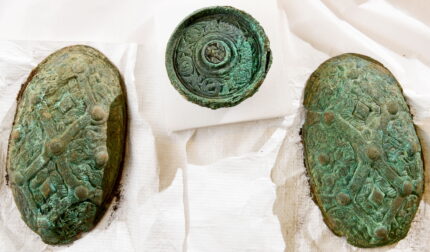 The brooches are beautifully decorated. Two of them are a matched pair of concave oval brooches decorated with interlocking animal motifs. Known as skålspænder (scoop brooches), this type of brooch was used to fasten apron dresses at the shoulder. They were found in women’s graves. Only one other pair has ever been found on the Isle of Man, and the newly-discovered pair is about 50 years older, so it’s evidence of the earliest Viking women’s grave on the island.
The third brooch is unique on the archaeological record of the Isle. It is round with a wide outer border, an inner band decorated with spirals and a central boss of colored glass. It was originally gilded, although only traces remains.
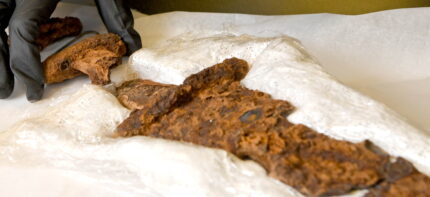
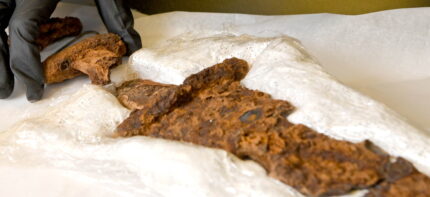
The sword found in the assemblage is also elaborately decorated. It is broken, likely deliberately as part of the funerary ritual, and about two thirds of it survives. The surviving hilt is decorated with silver inlay and twisted silver wire. Out of the 13 Viking swords found on the Isle of Man, only two others are so richly decorated.
The discovery also provides further evidence of trade and cultural connections across the Irish Sea. Decorated lead weights and fragments of bronze balance scales would have been used to weigh precious metals and coins during trading. The weights are the first of their type found on the Isle of Man.
One weight features a decorative bronze fitting, possibly reused from a small chest or religious object, with an artwork style typical of Britain and Ireland at the time. It offers a fascinating example of how Viking settlers adopted and reused objects from other cultures.
A bronze ladle, possibly used for feasting or ceremonies, is another type of object not previously recorded on the Island. […]
With several objects being the first of their kind found on the Island, the collection offers an important opportunity to learn more about Viking settlement, burial traditions and everyday life.